
Why automatic needle alignment matters
Frequent needle changes can require repeated position adjustments. Automatic alignment helps equipment respond to changes in the needle’s X–Y position and working height.
Manual alignment takes repeated checks and adjustments. Vision-based positioning can automate the process, but adds significant hardware, software and commissioning costs. For applications that only need to detect needle position, a sensor-based solution may offer an alternative aligned with equipment needs and budget.
How the sensor-based solution works
Through-beam fiber optic sensors detect the needle position in the X–Y plane. A contact sensor measures the needle height for Z-axis adjustment. The controller uses the detected values to calculate offsets and update the machine coordinates.
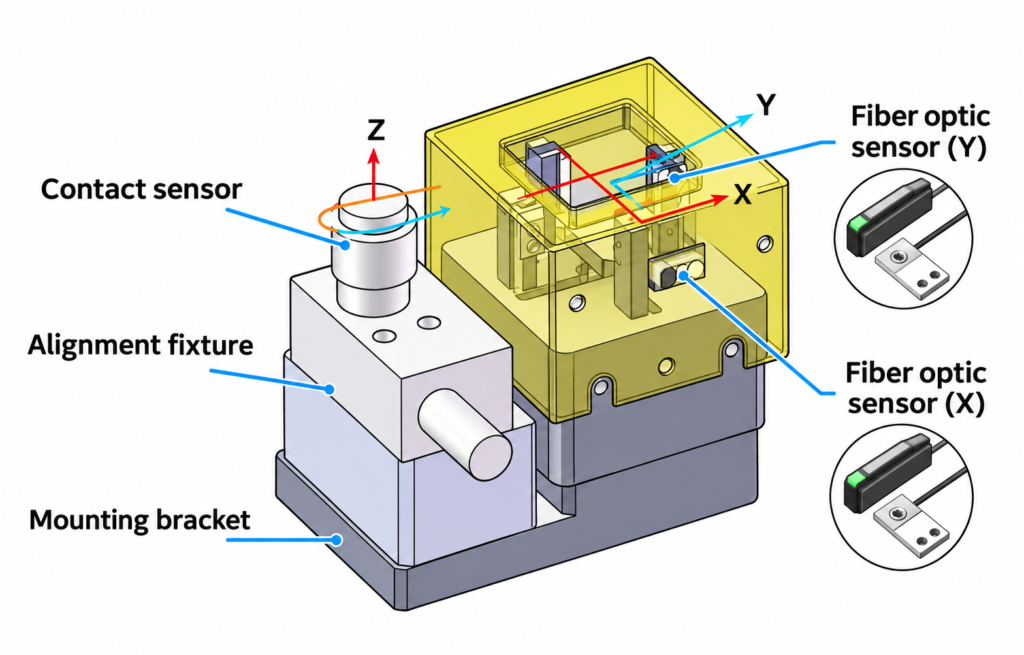
Step 1: Locate the needle in the X–Y plane
Two through-beam fiber optic sensing paths are arranged across the alignment area. The machine moves the needle through each path and the controller observes the sensor response. The detected positions are used to establish X and Y references and calculate offsets from the programmed position.
The specific detection method depends on the sensor output and control system. Alignment, sensitivity and motion settings should be tested with the actual needle and fixture.
Step 2: Check the needle height
For Z-axis measurement, the needle tip contacts a suitable sensor or measuring surface. The controller uses the resulting signal and known reference position to calculate the height offset, then applies the correction before dispensing.
Contact force, needle condition and the measurement sequence need to be suitable for the application. Whether the chosen device supplies a switching signal or a displacement value must be checked against its specifications.
Choosing sensors for the application
Sensor selection and optical arrangement should be based on the needle’s dimensions, shape, material and the machine’s installation space. The contact method and allowable force should also suit the needle and dispensing process.
Integration and verification
The machine controller must be able to read the sensor signals, manage the alignment sequence and apply the calculated offsets. Check repeatability across multiple cycles and after needle changes, and set practical limits for unexpected deviations.
Mechanical stability, vibration, sensor response and the motion system all influence results. The complete machine should be evaluated under its actual operating conditions.
Managing equipment costs
For a positioning task that does not require a full vision system, selecting sensors for the required measurement can help manage equipment and commissioning costs. The actual investment depends on the machine design and integration requirements.
Frequently asked questions
Does every dispensing machine need a vision system?
No. The appropriate method depends on what must be detected and the accuracy, flexibility and inspection requirements. A sensor-based approach may be suitable when the task is limited to needle alignment.
Can this solution work with different needles?
Different needles can require different optical sensors, mounting arrangements and contact methods. Select the sensing configuration around the actual needle and process.
Can the system automatically compensate for an offset?
It can when the machine controller is programmed to interpret the sensor signals and update the relevant coordinates. The details depend on the controller and machine design.
Discuss your application
Share your needle dimensions, desired alignment requirements, machine layout and controller details. We can help you review suitable sensor options and sourcing needs.